IRELAND -THE BURREN, PART 2

Continuing from the previous chapter - IRELAND - THE BURREN - Part 1 - on the 2nd day, the goal was still to explore County Clare, with the following attractions: Leamaneh Castle - Lisdoonvarna - Doolin Cave - Doolin - Fanore Beach - Black Head Lighthouse - Poulnabrone Dolmen.

Many stories circulate about Leamaneh Castle; according to legends, Máire and her husband (the lords of the castle) were considered cruel tyrants because anyone who opposed them was killed and their blood was smeared on the castle walls. Another legend says that after Máire's second husband died, on the very day of his death, she married a soldier, whom she threw out of the tower house's upper floor without any regret because he made insulting remarks about her second husband.
The name of the castle is the anglicised version of Léim an Eich, which means "the horse's leap". Máire allegedly promised the castle to whoever could jump over it with their horse.
The building consists of two parts: the 5-story tower was commissioned by Turlough Donn O’Brien, the king of Thomond, in the late 1400s, while the other building, the 4-story tower house was built by Conor O’Brien and his wife, Máire Ní Mahone, or as the people called her, Máire Rua (Red Mary). You cannot enter the ruins because the area is fenced off due to the cows grazing around it, and there is a private house behind it.

Our next stop was the town of Lisdoonvarna. The town, located in the heart of the Burren, is a famous spa town where the therapeutic benefits of the sulfur-rich water have been known since 1791. To bring the healing water to the surface, the first pump house was built in 1867, and later, in 1875, a bathhouse was also constructed alongside it. Since the 19th century, thousands of visitors have come to the city to seek treatment.
The town is also famous for its "matchmaker" event, which attracts up to 40,000 visitors every September.


Lisdoonvaarna also offers culinary specialities. It has a Michelin-starred restaurant, the Wild Honey Inn, and a world-famous salmon smokehouse - Burren Smokehouse.

The salmon smokehouse is the result of a chance meeting and love. The former owner of the Roadside Tavern met a Swedish girl visiting Lisdoonvarna, and from that meeting came love, marriage, and then a successful business. In 1989, they established the Burren Smokehouse, where, based on a method developed by the husband, they supply smoked salmon to restaurants both locally and around the world (including the Queen of England). At the suggestion of his wife, they opened the building to visitors in 1995, where a demonstration, smoked salmon products, and local crafts await the interested.
After Lisdoonvarna, our next stop was the Doolin Cave.
In 1952, a young team of researchers and cavers arrived in the Burren area to explore the mysteries of the earth's depths. Two boys separated from the group in the evening and, during their walk, noticed a spring that disappeared among the rocks. Moving the stones, they followed the water's path and crawled about 500 meters to reach the cave's main chamber as it is today. As they lit up the room with their lamps, they saw a massive stalactite on the ceiling, approximately 7 meters long.

The visit is only possible in a guided, organised manner. The tour lasts about 50 minutes and we descend 125 steps to reach the cave entrance. During the tour, we can see 2 rooms and they will also show us the crack through which the explorers entered the room. The painting of the stream flowing through the cave confirmed the hypothesis that there may be additional chambers connected to the already discovered area.
The highlight of the tour is the Great Salactite, which is the longest free-hanging stalactite in Europe. In the world, larger ones can be found in Mexico and Lebanon. The guided tour is well-structured, with interesting stories complementing the dry facts. Upon entering the room that hides the stalactite, for example, the lights must be turned off, and as the lights come on, a massive limestone formation hanging from the ceiling is revealed before us. A special feature is that if we look at it from the back, it is clearly visible that it shines in two colours.
At the visitor center, you can also find handcrafted ceramic products made from clay found in the cave. A short walking trail also starts from the cave entrance, which is worth checking out.


After the cave tour, we continued driving to the village of Doolin, the home of Irish music.
The vibrant, colourful little town is located on the Wild Atlantic Way route and on the edge of the Burren. Due to its gastronomy, beautiful natural features, and musical programs, it has become one of the favourite destinations for tourists in County Clare. The main street of the village is lined with pubs, restaurants, and cheerful, colourful houses. It's worth leaving the car here and walking down to the harbour.

We were lucky and found a parking spot at the beginning of the street, then a free table on the terrace of the famous Gus O'Connors Pub.
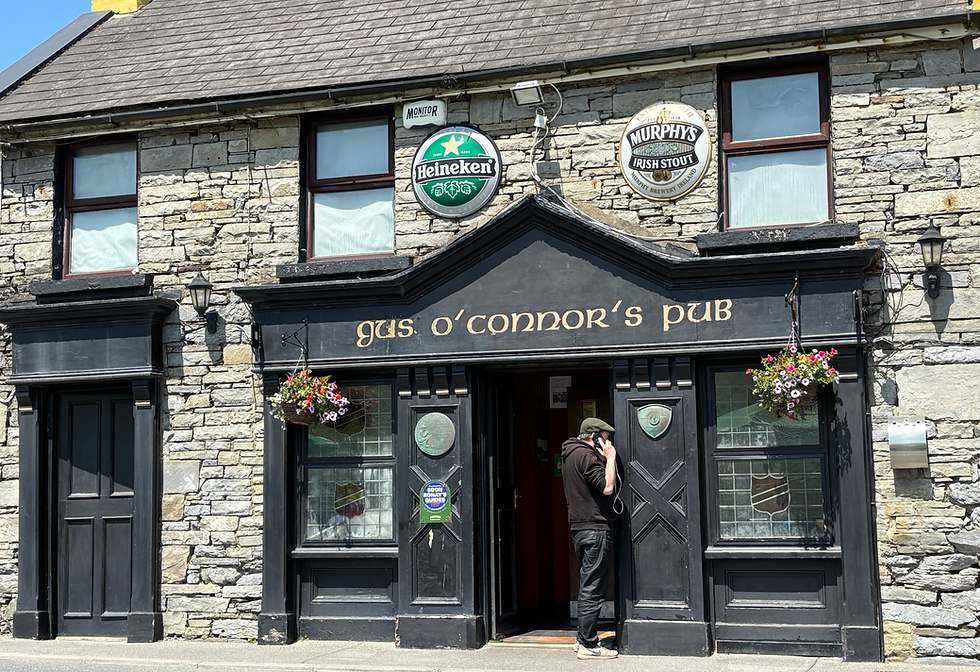
The pub was opened by the O'Connor family in 1932. From the very beginning, a prominent role was given to the cultivation and preservation of Irish musical traditions. Although the original owners have retired, the spirit of O'Connor has not changed at all over the past 40 years, and it still provides an opportunity for traditional Irish musicians to perform.

After our simple yet delicious lunch, we walked down to Doolin's harbour and the Atlantic Ocean shore.


We walked past the Seeweed Bath barrels on the beach. While chatting with the owner, we learned that the hot water filled with seaweed, the Irish version of Japanese onsens, has been in operation for 7 years. In Ireland, seaweed baths have a history of nearly a century. The health benefits of seaweed have long been known: it has a beneficial effect on the skin, joint pain, and sleep disorders. Booking is also possible online. It is worth checking the opening hours, as the service is seasonal.

From the ocean shore, Crab Island is clearly visible, which, thanks to the Earth's tectonic movement, broke off about 5000 km from here near the Equator and reached its current location over 300 million years.
We can also admire the Black Cliffs, which are the predecessors of the 10 km long Cliffs of Moher. The Aille River, which originates in Lisdoonvarna, flows into the ocean here through the cliffs and the cave system beneath Doolin.

On the shore, you can spend hours listening to the roar of the ocean, marvelling at the incredible power and beauty of nature. The karst limestone pavement, the characteristic of the Burren, can be clearly observed here too. The structure is sometimes interrupted by a larger, extending piece. It's a bit like someone had been playing ball with them and forgot to pick up their toy at the end of the game.

We walked from the beach to Doolin pier because we planned to take a ferry to the Aran Islands, and we were curious about the ferry schedule and prices. At the ticket office, we learned that in addition to the Aran Islands, there is also a route to the Cliffs of Moher, and it is worth buying the ticket for the ferry online. Website: https://doolinferry.com/
On the way back, we stopped at the famous Doolin ice cream shop in the village, but our traditional taste did not match the offerings.

From Doolin back home (Tubber, The Burren Barn), we chose the Wild Atlantic Way (2500km) coastal route (video here). Must-have program. You can only stop in certain places. These "parking spots" are usually set up near a landmark or viewpoint, and most of the time, you can also go down close to the shore.
Our first stop was Fanore Beach. Surprise and refreshment - perhaps these two words best described our feelings. A tidy little parking lot, clean restrooms, a snack bar, a lifeguard service in the summer, and a sandy beach framed by sand dunes. We put our shoes over our shoulders and happily walked hundreds of meters through the shallow water, avoiding jellyfish washed up on the beach. We were in a nostalgic mood because the beach reminded us a lot of Dee Why beach in Sydney.


After Fanore, the next stop was the Black Head Lighthouse. We almost passed it by, because, although the tower is visible from the road, there is nowhere to stop. Unfortunately, the lighthouse is not open to visitors, yet the broken-open gate suggested that the no-entry sign does not stop everyone.

We arrived at our last stop after 8 PM, and as you can see in the pictures, it was still light out. Atop the Burren plateau stands the Poulnabrone Dolmen, one of Ireland's most iconic and also the oldest megalithic monuments.

Poulnabrone is a portal tomb: two large portal stones stand on both sides of the entrance, capped by a roof stone. A second capstone covered the back of the structure, which now lies on the ground because it collapsed. The tomb was built on a limestone pavement and surrounded by a low stone mound. This stone pile supported the vertical stones, which otherwise would have been held in place only by the weight of the capstone. The limestone slabs used to construct the tomb were quarried from the surrounding limestone. Excavations carried out in the 1980s uncovered the remains of 33 people, including children and an infant. The bones were in good condition. It is assumed that the dead were first burnt elsewhere and only then brought here. According to radiocarbon dating, the tomb was continuously used for 600 years, from 5200 to 5800 years ago. The bones show signs of wear, indicating that the people who lived here did hard physical activity. Jewellery, pottery, and other items were also found in the grave.

This day of our vacation also went according to plan, and the weather continued to be kind to us.
For the next day, we put together a promising itinerary: Cliffs of Moher, Loop Head, and the Bridges of Ross. I'll write about this in the next post.
June, 2025


