IRELAND -THE BURREN - PART 1

In June, we spent a week in Ireland. When we visited Belfast in Northern-Ireland and discovered the wider area of the city, we fell in love with the beauty of the Irish landscape. We also decided that if we want to explore the country according to our own preferences, the most efficient way to do so is by car. There's a great website - https://www.theirishroadtrip.com/ - where you can plan an Irish road trip based on countless filtering criteria. For us, the first filter was the cities accessible from Budapest, then the maximum duration of 7 days. Dublin was in first place, but then somehow we stumbled upon Shannon Airport, which Ryanair flies to for a fraction of the price of the Dublin route. I confess, I had never heard of Shannon, but when I typed its name into the search engine of the previously mentioned website, it turned out that we had stumbled upon a real treasure. From the town of Shannon, you can organise such a "road trip" - which actually became a star tour - that it includes County Clare and The Burren.
What is a Burren?
The Burren - the stony land - is located in the northern part of County Clare. To the north, it is bordered by Galway Bay, to the west by the Atlantic Ocean, and to the south by Lisdoonvarna, Kilfenora, and Corrofin. Oliver Cromwell said: “There isn't a tree to hang a man, water to drown a man nor soil to bury a man”
Since we arrived in the morning and could only check into the accommodation in the afternoon, we planned an itinerary for the first day along the airport-accommodation route.
We rented a car from Europcar at the airport. Car rental companies (at least the big ones) only accept credit cards, not debit cards. In practice, this means (Europcar) that the deposit amount is slightly higher, but you can also pay with a debit card. We became the owners of a small compact Nissan Duke for a week.
Our first trip from the airport took us to Bunratty Castle and the Folk Park.

The original castle was built of wood on an earth mound in 1250. Over the centuries, it was destroyed and rebuilt several times. The current building was erected by the MacNamara family around 1425, and then through a gift or marriage, came into the hands of the O'Brien clan. VIII. During Henry's reign, the O'Brien family pledged loyalty to the king: they renounced their Irish traditions and Catholic faith in exchange for the title of "Earl of Thomond." By the end of the 20th century, the castle lay in ruins once again until Viscount Gort purchased it and, with the support of experts, began the restoration of the building. Today, it is the most completely and authentically renovated and furnished castle in Ireland.
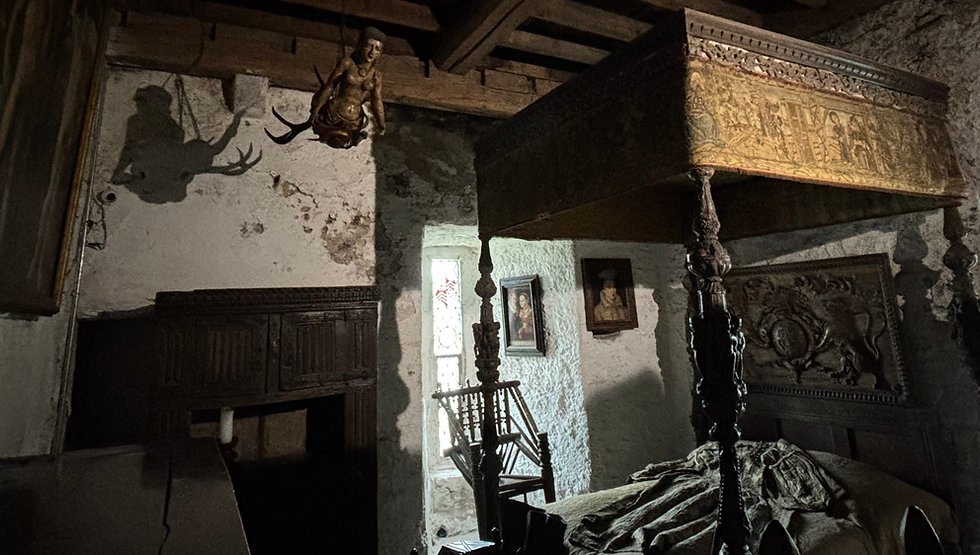
The building is not large, easily walkable. Definitely go up to the tower; from there, you get an excellent view of the surroundings.


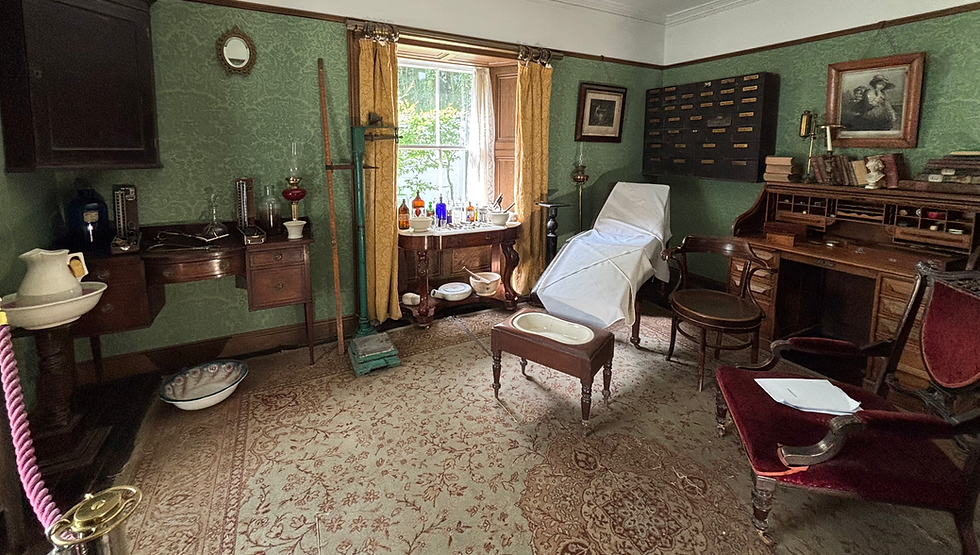
Next to the castle, a park similar to the Szentendre Open-Air Museum has been created, showcasing the typical economic, administrative, and community buildings of 19th-century Irish settlements. In the houses ladies dressed in traditional costumes provide more detailed information about the history and function of the specific buildings. The doctor's house and the school were particularly interesting, and the ladies also shared colourful stories about Ireland's past and present.




As dog owners, our greatest joy was spotting the two Irish Wolfhounds in the park, but the peacocks were also impressive.


After Bunratty Castle, we continued our journey towards our accommodation. The next stop was Knappogue Castle, followed by Quin Abbey / Quin Friary. We weren't lucky with the castle. We drove through the open gate, but it was suspicious that we only encountered a maintenance crew. The building was not accessible, and the area gave the impression of having seen better days. By the way, Knappogue is one of the most famous Irish whisky brands. Mark Edwin Andrews, the owner of Knappogue Castle, purchased whisky from the country's best distilleries. The barrels were further aged and then bottled under the Knappogue Castle brand. The last vintage, the 1951, was aged for 36 years and is regarded by experts as the oldest and rarest Irish whisky available on the market.
We approached the ruins of Quin Abbey from a parking lot after a small shop, having turned off the main street of the town. In the sky, between the occasionally gloomy clouds and the angry green field, stood the church defiantly facing the storms of history.
The original building was burnt down in 1278, and on its site, the Anglo-Norman lord Thomas de Clare built a castle. The MacNamara clan destroyed the castle, established an abbey in its place, and allowed Franciscan monks to settle there. Around 1640, the abbey functioned as a college, and ten years later, Oliver Cromwell killed the monks and also destroyed the monastery.


The church, in its current form, is still impressive and hints at its former beauty. The stone-carved windows and decorations, the inner cloister, and the old tombstones preserve the spirit of the past within the walls.


After the abbey, the next stop was The Burren Barn accommodation near the village of Ballinlisheen//Kilkeedy. The barn was converted into a guesthouse by the owners, Sinead and Edna. Apart from a few distant neighbours, we found ourselves in the heart of the Irish countryside, in the middle of nowhere. Our accommodation met all our needs and was within easy reach of everything by car.

After a few hours of rest, we decided to go to New Quay on Edna's recommendation. Our first trip was a "shocking" experience. My husband automatically looked for the gear shift on the other side, and I was terrified that we would crash into the bushes and stone walls by the side of the road. Around here, the roads are at most 1.5 cars wide, lined with low stone walls, but most often precisely trimmed, dense bushes and shrubs. The locals navigate with routine and vigour. We often couldn't decide whether the rearview mirror or the side of the car suffered from the narrow lanes. One thing is for sure, there were few vehicles that were intact and scratch-free. :-) The bumpy road (which is as smooth as glass compared to Hungarian roads) was also a challenge for the little Duke, and the interior rearview mirror ended up in our hands several times. :-)

New Quay is a small fishing village half an hour's drive from our accommodation. The village is interesting in several ways: its harbour, built in 1873, appears in one of Bernard Shaw's works; it is famous throughout Ireland for its gastronomy, particularly its local oysters and crabs, as well as its picturesque coastline.
The 8 km long Flaggy Shore is one of the northernmost parts of County Clare. Fossils embedded in limestone, "biokarst" rocks adorning the shoreline, the view of the Atlantic Ocean, and Aughinish Island make it special. In 1755, an earthquake shook the coasts of Portugal, and the subsequent tsunami also reached the western coast of Ireland. Some opinions suggest that Aughinish Island was separated from the mainland at this time.


New Quay is home of the Finavarra Tower (Finavarra Point). The tower, built during the Napoleonic Wars of 1812-16, protected Ballyvaughan Bay and New Quay harbour from French attacks.


On the way home, we took a different route and visited the (Shan)Muckinish West Tower House. The castle ruins are located halfway between Kinvara and Ballyvaughan, on the narrowest part of a small peninsula, overlooking Galway Bay. Shanmuckinish was once also known as Ballynacragga Castle and was built by the O’Loughlin family around 1450. The tower house is approximately 17m high. Some parts of the eastern and western walls have remained, while the coastal northern wall has completely collapsed.

The first day of our week-long vacation in Ireland went perfectly, and we looked forward to the rest with optimism. The weather looked promising, and we enjoyed that the sun set significantly later than at home.
You can see the route for Day 1 here:

In the next part, our journey continues in County Clare: a lighthouse, a cave, and a beach were on our itinerary.
June, 2025


