WEST LAKE, THREE POOLS

One of the most popular tourist spots on West Lake is “Three Pools Mirroring the Moon,” located on the lake’s largest island (Xiaoyingzhou). It gets its name from the three pagodas that stand in the water, each 62 meters apart, forming a triangle. (This image also appears on the 1-yuan) The pagodas were first built in 1090 and took on their present form during the Ming Dynasty, under the reign of Emperor Wanli. The pagodas rise 2.32 meters above the water. The lower section consists of a hollow sphere, each with five windows decorated with reliefs. The upper part is a hollow hexagonal cylinder, with one square opening in each direction. During the autumn festival, candles are placed in the windows, and the holes are covered with thin paper. Some poets say that, when viewed from here, the mountains are wrapped in clouds, just like a painting from the Song Dynasty; the Sue causeway stretches like a silk ribbon between the willow-lined shore and the bridges; the sparkling blue of West Lake and the pagodas rising majestically from the water combine to create perfect harmony and tranquility.
The island itself is divided into four sections, with small walkways connecting the four ponds. The area was also once a center of Buddhism. Buddhism arrived in China from India during the Han Dynasty and reached its peak during the Southern Song Dynasty. To this day, there are three Buddhist temples on the island:
Located in the southern part is the Woxinxinagyin Pavilion, standing 7.2 meters tall. It is a classic Qing-style building, and its name refers to its Buddhist past: “understanding each other without words.”
An interesting feature of the Wanzi Pavilion is that it is shaped like the ancient Buddhist symbol, the swastika. It was built by Emperor Guangxu during the Qing Dynasty and was rebuilt in 2005 while retaining its original form.
The Kaiwang Pavilion is a triangular wooden pavilion with a pyramid-shaped roof. Its name has Buddhist origins: even though one side of the net is left open, it still keeps the fish captive.
Another iconic feature of the island is one of the inner ponds, the “Fish Pond.” It took on its final form during the Ming Dynasty, and hibiscus plants were planted along its banks. It was believed that the blooming hibiscus flowers and the goldfish would create an enchanting contrast of colors.
The nine lions sculpture was placed on the island during the reign of Guangxu. In reality, it is a rock in which, thanks to its naturally formed curves and hollows, one can make out nine small, playful lions (though it does require a vivid imagination).
In addition to its historical memories, the island’s natural features are also breathtaking. As the seasons change, the landscape is constantly transforming. Although the island is enchanting even in winter, especially when there’s snow, spring and summer are the most beautiful seasons. At this time of year, the inner pools are covered with lush, green, and/or blooming water lilies and lotuses
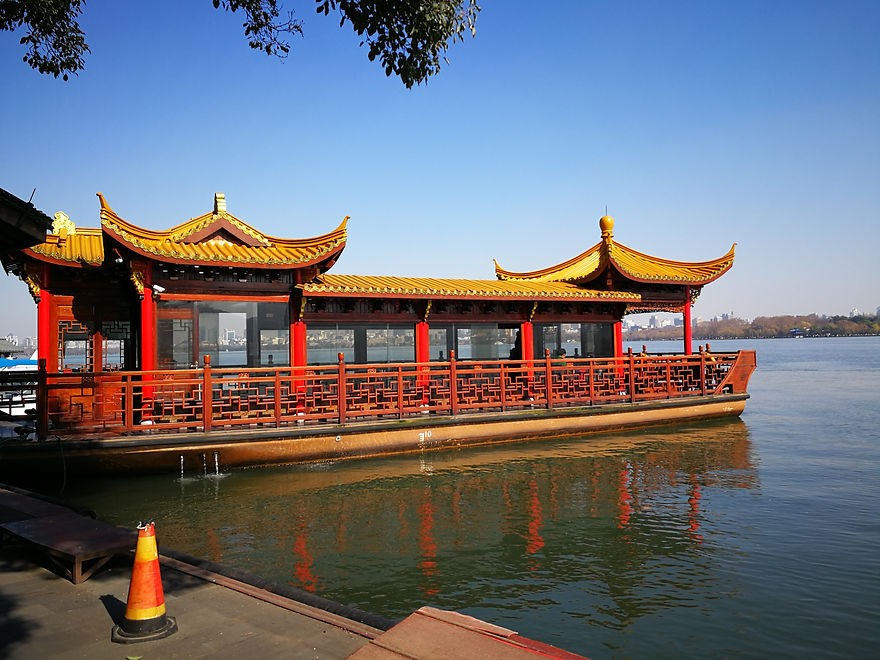
You can get to the island several ways: by dragon boat, the big golden dragon, or smaller boats. The mainland docks are also connected to various landmarks around West Lake, offering additional opportunities for excursions and sightseeing.
March, 2018


Dragon boats connect the island to the mainland


The Imperial Stele Pavilion
The Stone with Nine Lions

Wanzi Pavilion and the Kaiwang Pavilion