IRELAND -THE BURREN, PART 4

Continuing from the previous chapters (a week-long vacation in Ireland's County Clare and the Burren region), Day 4 was about chocolate, perfume, and sightseeing.

Before diving into the world of chocolate and perfume, we stopped at the Fahee North Geopark. The area is the result of millions of years of erosion of the limestone, primarily caused by chemical dissolution from rain and groundwater, as well as the massive moving ice sheets. From the top of the hill, there is a perfect view of the landscape characteristic of the Burren.

In the area, several grassy circular mounds can be seen. These are called "fulacht fiadh," stones heated in a fire, which were used to warm water about 5000 years ago. There are also so-called prayer columns. These are stone piles assembled with a stone placed upright in the center.

After the geopark, we continued driving to the small center of Burren Perfumery.

The perfumery is a family business that uses local plants to create creams, perfumes, soaps, and candles from natural ingredients. Founded in 1972, it is Ireland's oldest operating perfumery workshop. In the main building, there is a shop where the natural products can be purchased. The perfumes were not to our taste, their scent did not match our preferences. With creams, the main selection criteria are more about the content and therapeutic effect, so it's easier to find a suitable one among them.

In the outbuildings, we can visit the Perfume room, where perfumes are made and packaged. In the Blending room, we can get a glimpse into the making of organic creams and balms.

In the Candle and Soap Room, we can learn the tricks of making candles and soap. For soaps made using the cold process, shea butter, coconut oil, and olive oil are used, which are mixed with other natural ingredients. The soap solidifies over 6 weeks and can then be sent to the packaging section. The candles are hand-poured, with the addition of soy wax and essential oils.
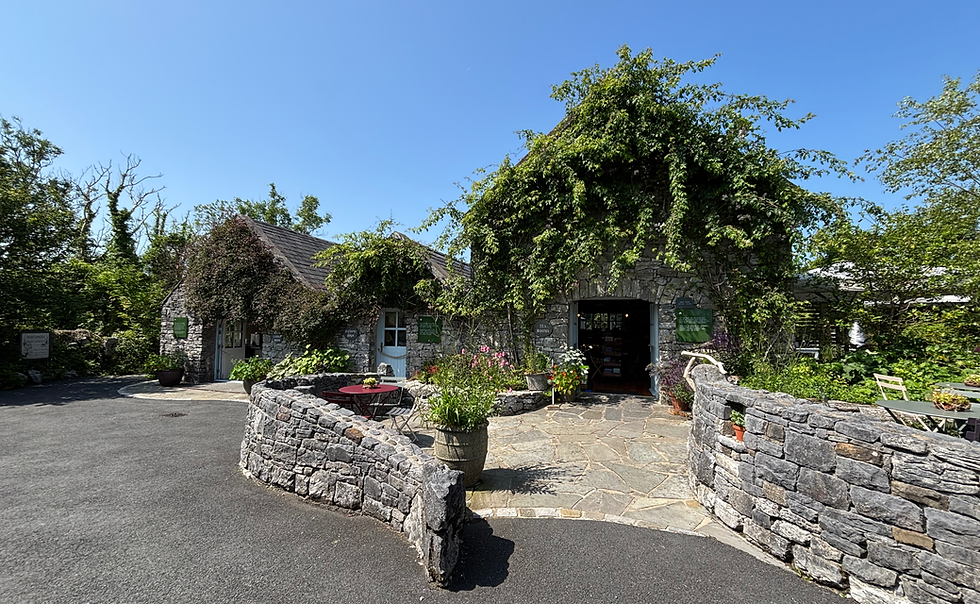
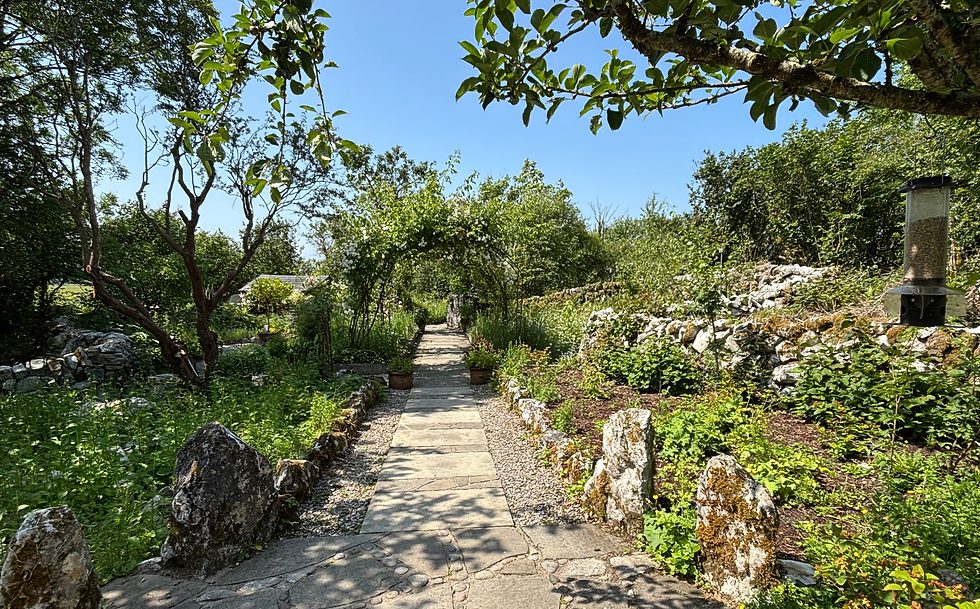
The organic herb garden was planted in 1999 with the aim of showcasing native herbs and their potential uses. In the garden, several secluded spots have been created where we can sit down and quietly admire the plants.

After perfumes and creams, another delight awaited us at the Hazel Mountain Chocolate - Burren Chocolatier.

In 2014, the family business opened its doors to visitors. They are among the top 10 gastronomic attractions in Ireland, returning with prestigious awards from numerous domestic and international competitions. One of their notable appearances was on the show of celebrity chef Nigella Lawson, where Nigella "fainted" over their hot chocolate.

They source cocoa beans from smaller producers, and the milk comes from cows grazing on Irish grass. They strive to use less sugar and environmentally friendly packaging solutions.

Our first city tour on our week-long trip was in Galway. Since it hasn't rained at all so far and there haven't been any crowds, we've been progressing through our planned activities much faster than we initially calculated. So we came up with the idea of going to Galway and then to Limerick. Dublin would have fit into our schedule, but we thought we would go there later, allowing time not only for sightseeing but also for exploring the surrounding area.
We really weren't prepared for anything and we didn't have a list of sights either. We parked near Eyre Square and set off "aimlessly." We were immediately captivated by the city's youthful, vibrant life, the many pubs and small restaurants, and the street musicians creating a unique atmosphere.
Eyre Square - or John F. Kennedy Memorial Park - once the site of the market. Today, it is a popular gathering place for both visitors and locals alike. In the square stands J. F. K.'s statue, who was made a citizen of the city. The statue marks the spot where he delivered a speech on his last journey before his assassination in 1963.

At the northern end of Eyre Square stands a door, the former entrance to the Browne House of 1627 (Browne-doorway). The Browne family was one of the 14 clans that dominated the city's political, economic, and social life for over two centuries. The entrance is an excellent example of Renaissance architecture, influenced by the Italian style that was popular at the time. Under the window, there is a Latin inscription from Psalm 127:1: "Nisi Dominus aedificaverit domum, in vanum laboraverunt, qui aedificant eam" (Unless the Lord builds the house, they labor in vain who build it). The gate has also witnessed Galway's turbulent history. In 1652, during the conquest of Ireland, Galway surrendered to the English forces after a nine-month siege. The Browne House was confiscated and later demolished, along with many other houses of the tribes. The entrance was spared and remained in its original location until 1905, when it was moved to Eyre Square as part of a city development program.

The 14 tribes (Athy, Blake, Bodkin, Browne, D'Arcy, Deane, FFront, Ffrench, Joyce, Kirwan, Lynch, Martin, Morris, Skerritt) were 14 merchant families who influenced and dominated the political, commercial, and social life of the city of Galway between the mid-13th century and the late 19th century. Of the 14 families, 12 were of Anglo-Norman descent, while two were Gaelic Irish. The oldest tribe was the Kriwan, and the most influential was the Lynch tribe. The board presenting the tribes can be seen in the city center of Galway.

Eyre Square is the gateway to the city's main shopping street, where you can buy souvenirs, quality Irish knitwear, and Claddagh rings. The distinctive design of the Claddagh features two clasped hands surrounding a heart, topped with a crown. These symbolise love (heart), friendship (hands), and loyalty (crown). Although various myths and legends circulate about the origin of the Claddagh ring, it is almost certain that it originated in or near the fishing village of Claddagh.

Kirwan's Lane is a mediaeval alley named after the Kirwans of the 14 tribes. It is located in the heart of the Latin Quarter, which was once an area within the city walls and is now a vibrant center of culture, entertainment, and gastronomy. The street is home to numerous historical plaques and monuments that tell the story of Galway's rich history.


Just like in Belfast, several houses are decorated with paintings on their walls.


The Spanish Arch was built in 1584 on the left bank of the River Corrib, where the river meets the sea. It housed soldiers who stood guard and operated the cannons. The name Spanish Arch is misleading because it has nothing to do with the Spanish. In the Middle Ages, European ships carrying wine and spices - including Spanish ones - also docked here and sold their goods at the docks. Christopher Columbus also visited Galway in 1477. In 1755, the Spanish Arch was partially destroyed by a tsunami and then expanded.

The arch, alongside Eyre Square, is another iconic meeting point in Galway.


Just like the previous days, this one was perfect as well. The weather kept going against forecasts, and the sun was shining brightly.
In the coming days, the Aran Islands and Limerick were on our agenda, and I'll write about that in a future post.
June, 2025


